Category — Medieval Art
News – Codex Calixtinus Stolen
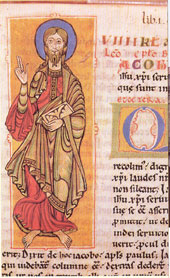 One of the rarest and most beautiful illuminated manscripts dating from the 12th century is missing from the cathedral of Santiago de Compostela. It is the Codex Calixtinus. The miniature of Saint Jacob above is from this guidebook. It is a book that will literally take your breath away with it’s beauty. Here is the link to the story on the BBC News site.
Here is a second link to the story in the Guardian with a beautiful leaf from the codex.
July 7, 2011 3 Comments
Making Your Own Illuminations Part 2 – Superman Comics, Medieval Illuminations and Miniatures
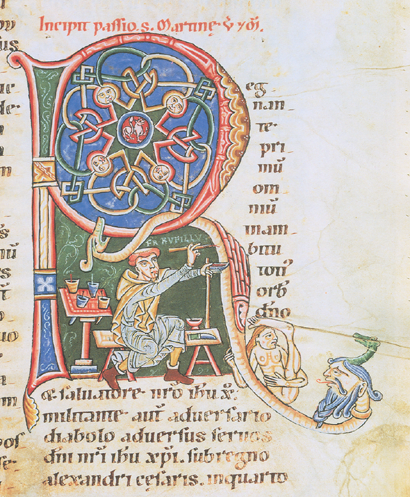
Frater Rufillus of Weissenau self-portrait in decorated initial from Medieval Illuminators and Their Methods of Work
Did I get your attention with the title of this lesson? I hope so. Besides medieval history, one of my interests is comic book art. Until recently, when digital methods superseded hand-drawn art, comic books were made in the same way that medieval artists created their magnificent illuminated books. There are three parts to creating the figure art in a comic book. The penciller draws the comic in the familiar framed format of the comic book, the inker inks over the lines drawn by the penciller and the colorist colors the image to produce final art. One person or many people may be involved in this process. This is exactly how medieval artists created their books and it is how we will create our illuminated writing.
This will require a few simple tools. The first, of course, is paper. My personal preference is 500 series Strathmore Bristol plate surface. Your choice should be made based upon your materials. I use watercolor, ink, some acrylics and colored pencils for my writing. They all work well on this surface. Since this is all for fun and for learning and for making mistakes, feel free to use whatever you have on hand. If you decide to continue beyond these simple tutorials, then you can purchase more expensive supplies at that time.
Many folks feel great anxiety when faced with drawing anything. If this is you, you might want to consider purchasing transfer paper. If you’re scared, intimidated and freaked, relax. You can choose images you want to replicate and transfer them to your drawing surface using carbon paper. Something like was done in medieval times and you can do it, too. You can even do it on the cheap. Take a piece of cheap printer/copier paper and cover one side with lead from a 2B pencil. This is a little messy but it will allow you to carbon transfer your image.
Planning the writing, requires ruling the page. A ruler will suffice. A ruler and a triangle are better. In addition to the basic tools, I have a series of french curves and ellipsoid templates. These are very useful and speed the process.
Finally, we come to the actual tools used to put design and color on the page. You will need a pencil, not too hard and not too soft. You will need something to make a permanent fine black line such as a Pigma Micron or Copic multiliner/marker. I use a fountain pen and/or a dip pen with Noodler’s Ink for my writing. You don’t need to get fancy and a simple finepoint black Sharpie marker will do. Use what you have and keep it cheap.
I’ve left color and illuminating gold for last. How you do this depends on what effect you want to achieve. Is this just a fun exercise and you’re doing it all on the cheap? Fine, use some watercolor and/or colored pencil. Are you trying for the look of an old book or do you want your writing to have the look of a brand new manuscript? What we see today are faded versions of the original writing. The colors were brilliant and intense when the original pages were created but the palette was limited. Look at the decorated letter at the start of this tutorial. Notice the little bowls of color the artist is using. You will need only a basic color set in whatever media you choose.
Derwent Inktense Watercolor Pencils
Do you want it all in a simple package? Derwent Inktense Pencils are fantastic tools for creating bright, bold colors and outlining with “ink”. The smallest set will provide all of the colors you need. The very nice part about these pencils is that they come with a black (ink) outlining pencil that is waterproof. It’s all there except for the illuminating gold. I use these pencils all the time and you can get many different effects with them.
Dr. Ph. Martin’s Hydrus Fine Art Watercolor Sets
I use Dr. Ph. Martin’s Hydrus Watercolor to color my writing when I want striking brilliant color.
Illuminating Gold
I use a gold paint from Golden Acrylics called “Iridescent Gold Deep (Fine)” for illuminating my writing. To start, I suggest you use one of the many available metallic gel markers. They’re cheap and easy to find.
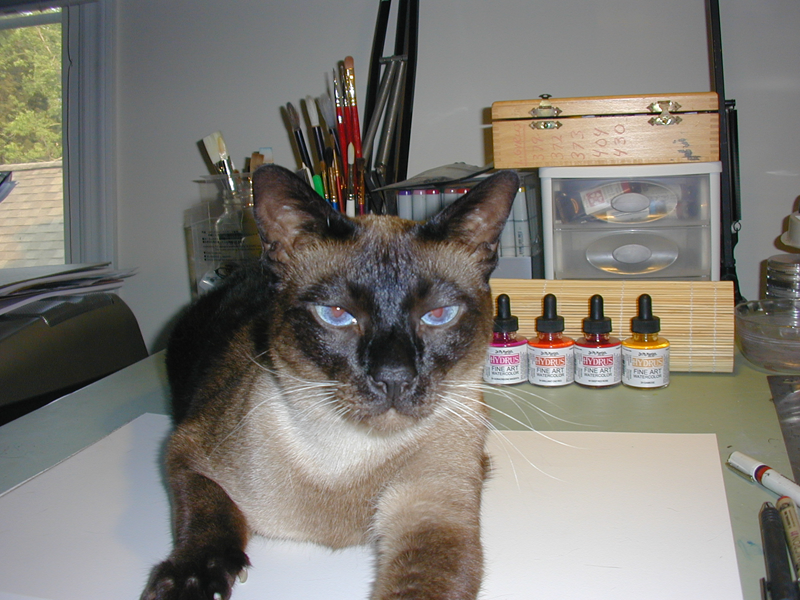
That covers everything you will need to get started. In the next lesson, we’ll start looking at putting design on the page. Have fun with this. You might find a hobby that will last a lifetime. Finally, invite a friend to try it with you. It’s more fun that way. Here’s my friend. He’s always eager to give me a helping hand….
May 22, 2011 2 Comments
CBS News 60 Minutes Visits the Vatican Library
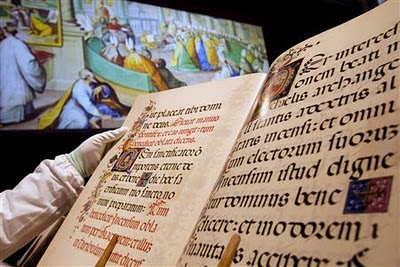 I hope everyone stayed tuned to CBS after the Masters yesterday to watch 60 Minutes. They did a marvelous piece on the Vatican Library with Morely Safer as host. In case you missed it, video is available at CBS News.
April 11, 2011 Comments Off on CBS News 60 Minutes Visits the Vatican Library
The Vatican Library – The Pope’s Library
 Since the Pope is visiting, I thought I’d call attention to the Vatican Library Exhibit on the Library of Congress web site. It’s a very informative short history of Rome and the library with a gallery of book manuscripts including many that are illuminated. The history of the Vatican Library is a fascinating story and what book lover hasn’t imagined roaming those stacks and finding a long lost book? From the Library of Congress page:
The Vatican Library, in fact, became a center of the revival of classical culture known as the Renaissance. Its librarians were often distinguished scholars. Historians and philosophers, clerics and magicians visited the collections and borrowed books from them. By 1581, when the French writer Michel de Montaigne visited Rome, the treasures of the Vatican had become a mandatory stop on any well-informed traveller’s Roman itinerary. To his delight, Montaigne was shown ancient Roman and ancient Chinese manuscripts, the love letters of Henry VIII, and the classics of history and philosophy (many of which can be seen in this exhibition). Then, as now, the Vatican Library was one of the greatest in the Western world.
April 16, 2008 Comments Off on The Vatican Library – The Pope’s Library
“Illuminating the Medieval Hunt” at the Morgan
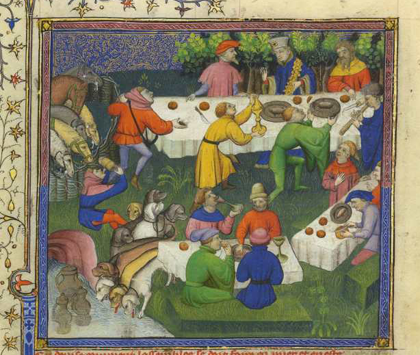
The Morgan’s copy is thought to have been commissioned by Philip the Bold’s son, John the Fearless (1371–1419), who presumably inherited his father’s manuscript and had copies made. During the late Fifteenth Century, it was owned by King Ferdinand II of Aragón and Queen Isabella of Castile, who added to it their full-page coat of arms. Of the 46 known surviving copies of the manuscript, the Morgan’s is one of the two finest extant examples; the other, in the Bibliothèque nationale de France, was made at the same time and contains the same cycle of 87 miniatures.
Le Livre de la chasse is divided into four books — on gentle and wild beasts; on the nature of dogs and their care; on hunting in general and hunting with dogs; and on hunting with traps, snares and cross bow. Written in French, the work was enormously popular throughout Europe and England, where it was translated under the title Master of Game.
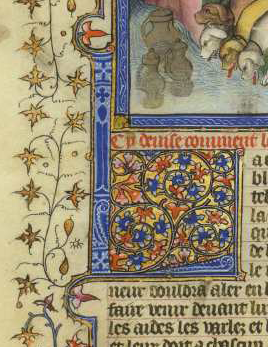 The manscript is richly decorated and the miniatures are unique windows to observed medieval life. The manuscript is from a famous court. This was a historically critical time of rapid cultural evolution following the black death of the previous century. If you are unable to make it to the Morgan to see this book, a large selection of images from another copy of this 15th century manuscript is available here.
April 2, 2008 Comments Off on “Illuminating the Medieval Hunt” at the Morgan