Category — Medieval News
The Joy of Illuminated Writing and Your Favorite Fictional Monks
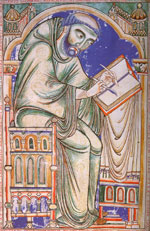
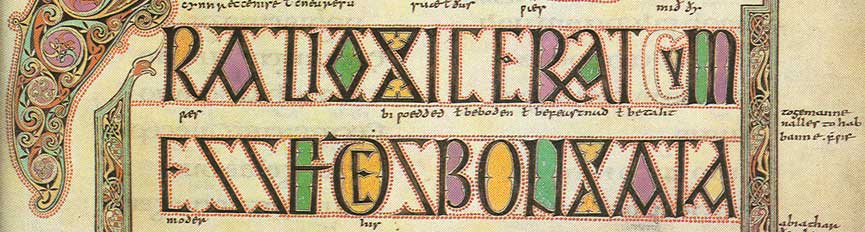
I came across two news stories this morning about some of my favorite things. The first is, of course, about illuminated writing and an exhibition at the Ghetty in southern California. I’m always feel a little sad that I never made it to the Ghetty while I lived in San Diego but it was a very long and tedious drive. Danna Staff has a wonderful post in her physics blog titled The Caligrapher’s Golden Touch. I think she captures the joy and excitement that we feel as admirers of illuminated writing.
I was not a gum-chewing child–but I was an amateur calligrapher, in addition to being infatuated with illuminated manuscripts. After looking at Ingmire’s series at the Getty, I thought, “Maybe I’ll try this when I get home!”
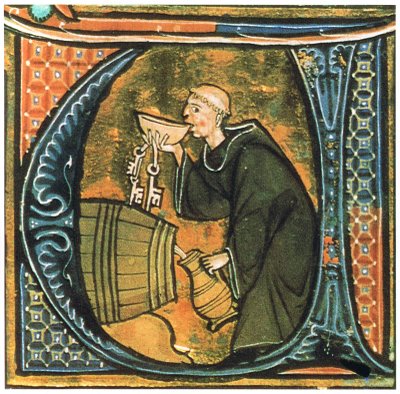
The second news item is from the Guardian: Force of habit: who are your favourite fictional monks? I vote for Brother Cadfael. I love that series and I have it all on DVD. Who is your favorite fictional monk?
March 21, 2012 2 Comments
10th Annual Marco Symposium at The University of Tennessee March 1-3 2012

Be there or be square! I’ll be there on and off as time permits.
From The University of Tennessee’s events calendar:
“Grounding the Book: Readers, Writers, and Places in the Pre-Modern World”
The 2012 Marco Symposium, co-organized by Thomas E. Burman (history), Maura Lafferty (Classics), and Anthony Welch (English) will bring together up to ten scholars from a range of disciplines to explore the complex interaction between pre-modern writers and readers, their books, and the places-libraries, museums, monasteries, university classrooms, the courts of patrons-where they wrote and read them. A substantial amount of recent scholarship in the interdisciplinary field of the history of reading has made clear the countless ways in which understanding the materiality of texts sheds fascinating light how on those texts were read and deployed. The layout of a copied or printed page, the other works with which a text appears in a book, the marginalia that so frequently appears in margins: all these and many other aspects of the ‘material text’ open valuable windows through which we can catch glimpses of writers and readers interacting with texts.
Read the rest here.
February 21, 2012 Comments Off on 10th Annual Marco Symposium at The University of Tennessee March 1-3 2012
News – Codex Calixtinus Stolen
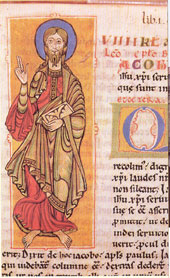 One of the rarest and most beautiful illuminated manscripts dating from the 12th century is missing from the cathedral of Santiago de Compostela. It is the Codex Calixtinus. The miniature of Saint Jacob above is from this guidebook. It is a book that will literally take your breath away with it’s beauty. Here is the link to the story on the BBC News site.
Here is a second link to the story in the Guardian with a beautiful leaf from the codex.
July 7, 2011 3 Comments
Enjoying the Filth of the Middle Ages from a Safe Smelling Distance
 First, a bit of an apology for having been away for so long but life does intrude. Next, a promise, we have tons of new images from books of hours for the gallery. We’ll be uploading them soon. Finally, we’re thinking of providing some video tutorials on recreating the lettering and art from medieval times with modern tools and materials for art journaling or other popular craft applications. We would appreciate your imput on this idea.
In the medieval sanitation and recycling department, here is a fine list of why medieval London probably smelled worse than we can imagine from our place in time. From, The Telegraph, “Medieval London: 10 disgusting facts:”
1. The inhabitants of medieval London (human and animal) produced 50 tons of excrement a day.
2. In medieval London, there were no pavements – people had to walk on the bare earth. Except, unfortunately, it wasn’t bare earth – the ground was covered with the excrement of both people and animals, as well as animal entrails and rotting food.
To read the rest, follow this link.
April 5, 2011 2 Comments
“Illuminating the Medieval Hunt” at the Morgan
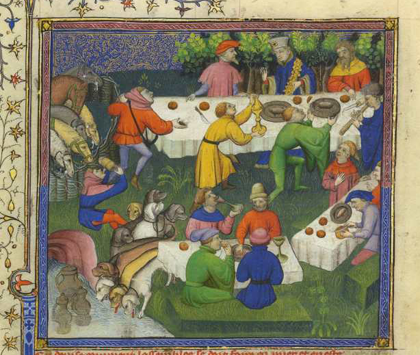
The Morgan’s copy is thought to have been commissioned by Philip the Bold’s son, John the Fearless (1371–1419), who presumably inherited his father’s manuscript and had copies made. During the late Fifteenth Century, it was owned by King Ferdinand II of Aragón and Queen Isabella of Castile, who added to it their full-page coat of arms. Of the 46 known surviving copies of the manuscript, the Morgan’s is one of the two finest extant examples; the other, in the Bibliothèque nationale de France, was made at the same time and contains the same cycle of 87 miniatures.
Le Livre de la chasse is divided into four books — on gentle and wild beasts; on the nature of dogs and their care; on hunting in general and hunting with dogs; and on hunting with traps, snares and cross bow. Written in French, the work was enormously popular throughout Europe and England, where it was translated under the title Master of Game.
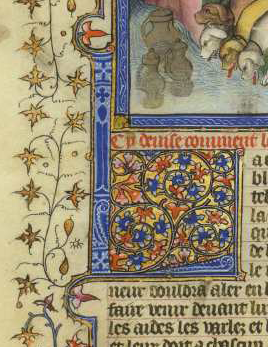 The manscript is richly decorated and the miniatures are unique windows to observed medieval life. The manuscript is from a famous court. This was a historically critical time of rapid cultural evolution following the black death of the previous century. If you are unable to make it to the Morgan to see this book, a large selection of images from another copy of this 15th century manuscript is available here.
April 2, 2008 Comments Off on “Illuminating the Medieval Hunt” at the Morgan