Category — Medieval Art
Foundation Musick’s Monument
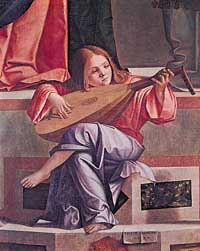 Sometimes something is just cool. FOUNDATION MUSICK’S MONUMENT is cool. Here is how they describe themselves:
The Stichting Musick’s Monument produces Historical Art Productions, partly in association with scholars from the Chair of Humanities of the University of Amsterdam (UvA). Pictures, music and text are integrated: You will hear music from the same period and the same area of origin as the visual materials; these are supplemented with explanatory text. From this combination evolves something like a Gesamtkunstwerk (a total work of art), a complete new way of digital art presentation.
This page has a great video. Be patient. Some things on this site take quite a bit of time to load but it’s worth the wait.
March 31, 2008 Comments Off on Foundation Musick’s Monument
The Museum of Biblical Art in New York City Exhibiting 50 Medieval artworks in “Realms of Faith: Medieval Art from the Walters Art Museum”
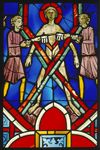 The Walters Art Museum in Baltimore has one of the premiere collections of Medieval Art in the United States. Fifty works from this splendid collection are on exhibit in the Museum of Biblical Art in New York City (MOBIA) through July 13 of 2008. From the Home News Tribune:
In this exhibition, a selection of both rarely seen and well-known pieces, from geographic origins that stretch from Spain to Turkey and Russia to North Africa, provide the viewer with an introduction to the great diversity of medieval art forms and styles.
Delving into the art, history and religion of the Middle Ages, visitors will discover the ritual function of religious objects and the rich symbolic meanings the artworks had for their medieval users. With an array of public programs that include a family-friendly Medieval Fair, “Realms of Faith” is designed to open a window onto the past.
The MOBIA web site (link above) offers a beautiful on-line slide show of some of the items in this featured exhibit. From MOBIA:
Unlike today’s world, in which we commonly insert a divide between the sacred and secular realms, during the medieval period Christians sought biblical connections to all aspects of their everyday lives. Artists in the western European nations and eastern Byzantine Empire alike expressed their personal faith and satisfied the desires of their patrons by creating objects that served as “crafted confessions” of their beliefs. Supplemented by books and loose leaves from the collection of the American Bible Society, these declarations of devotion demonstrate the inspirational adaptability of Christian ideas, which provided a catalyst for the manufacture of medieval artworks. In a museum setting, it is easy to forget that these objects were not made to be set within glass cages. They were vital components of the living faiths of the people who used them. The impact these artworks exerted is examined in three arenas of medieval life: the Realm of Liturgical Celebration, the Realm of Private Devotion, and the Realm of Domestic Life.
This sounds like a great show but if you can’t get there make sure and visit MOBIA’s site and Walters Museum site to see the art on-line.
March 15, 2008 Comments Off on The Museum of Biblical Art in New York City Exhibiting 50 Medieval artworks in “Realms of Faith: Medieval Art from the Walters Art Museum”
“A Tale of Two Manuscripts Reunited” – 14th Century Medieval Love Poem
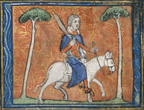 Two 14th Century love poems have been reunited at the University of Chicago. From their press release:
The University of Chicago Library acquired a 14th-century manuscript of “Le Roman de la Rose,” or “The Romance of the Rose” – which scholars have referred to as the most popular medieval love poem – reuniting it after a 100-year separation with a manuscript with which it was previously bound.
In 1907, the manuscript of “Le Roman de la Rose” was separated from that of “Le Jeu des Echecs Moralise,” or “The Moralized Game of Chess,” which the University of Chicago Library acquired in 1931.
Both manuscripts will be on display in the Library’s Special Collections Research Center at 1100 E. 57th St., beginning Feb. 14 as part of the exhibition: “Romance and Chess: A Tale of Two Manuscripts Reunited.” Opening remarks will be made at 12:30 p.m. at the Valentine’s Day opening by Alice Schreyer, Director of the Special Collections Research Center; Daisy Delogu, Assistant Professor of Romance Languages and Literature; and Aden Kumler, Assistant Professor of Medieval Art and Architecture at the University of Chicago. The event is free and open to the public. The exhibit will run through March 14.
“Bringing the two parts of this book back together will enable discoveries that would not be possible if they remained apart,” Schreyer said.
Added Delogu, “This ‘Le Roman de la Rose’ manuscript has extraordinary potential to enrich research and teaching opportunities here at Chicago, and will be of interest to scholars of manuscript culture and literary studies worldwide. ‘Le Roman de la Rose’ is arguably the single-most influential vernacular text of the late French Middle Ages.”
These beautiful manuscripts are currently on display at the University of Chicago. You can learn more about the history of these 14th century poems at the University of Chicago Library web site.
March 4, 2008 Comments Off on “A Tale of Two Manuscripts Reunited” – 14th Century Medieval Love Poem
Introduction to Manuscript Studies from Raymond Clemens and Timothy Graham
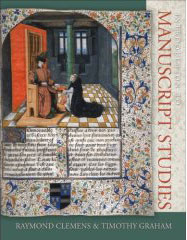 A wonderful new book on medieval illuminated manuscipts is coming from Cornell University Press in October. Drs. Raymond Clemens (Illinois State University) and Timothy Graham (University of New Mexico) are publishing Introduction to Manuscript Studies
Providing a comprehensive and accessible orientation to the field of medieval manuscript studies, this lavishly illustrated book by Raymond Clemens and Timothy Graham is unique among handbooks on paleography, codicology, and manuscript illumination in its scope and level of detail. It will be of immeasurable help to students in history, art history, literature, and religious studies who are encountering medieval manuscripts for the first time, while also appealing to advanced scholars and general readers interested in the history of the book before the age of print.
From the University of New Mexico press release:
The book explains in detail how parchment, inks and papers were made, and includes recipes used by medieval workmen. It explores the art of decoration and gives special attention to conventions of punctuation and abbreviation and the genres of manuscripts including books of hours, maps, calendars, rolls and scrolls. There is also an explanation of how to establish the origin and provenance of a manuscript.
Break open your piggy bank. This book looks like the best resource that has been published in many years.
[tags]medieval manuscript, calligraphy, medieval studies, cornell university press, raymond clemons, timothy graham[/tags]
August 28, 2007 Comments Off on Introduction to Manuscript Studies from Raymond Clemens and Timothy Graham
Medieval Treasures from the Cleveland Museum of Art Travel to the Ghetty
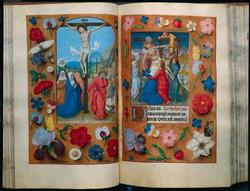 The Cleveland Museum of Art is the holder of many rare and beautiful medieval treasures including the Hours of Queen Isabella the Catholic, Queen of Spain, shown on the left. If you are in southern California this fall, you will be able to view part of this collection at the J. Paul Ghetty Museum. From the Ghetty press release:
The Cleveland Museum of Art houses one of the finest and most comprehensive collections of Early Christian, Byzantine and European Medieval art in the world. This remarkable collection was largely acquired over a period of 90 years and formed by two of America’s most distinguished medievalists, the museum’s second director, William Milliken, and the collection’s former curator, William Wixom. The Cleveland Museum of Art’s $258 million renovation and expansion project created the opportunity for the first traveling exhibition to showcase more than 120 masterpieces in a variety of media from its medieval collection. Some of these objects will travel for the first time since they were acquired by the Cleveland Museum of Art.
“This exhibition offers a unique opportunity to bring some of the world’s finest medieval treasures to Los Angeles,†says Michael Brand, director, the J. Paul Getty Museum. â€It will present highlights from the Cleveland Museum of Art’s collection chronologically according to their place of origin, allowing visitors to appreciate the aesthetics of a particular time and place, as well as understand the general artistic progression during this significant period in European art.â€
[tags]cleveland museum of art, j. paul ghetty museum of art, medieval manuscript, medieval art[/tags]
August 22, 2007 Comments Off on Medieval Treasures from the Cleveland Museum of Art Travel to the Ghetty