The Vatican Library – The Pope’s Library

April 16th, 2008

Biography of the Popes, scribe was Bartolomeo San VitoSince the Pope is visiting, I thought I’d call attention to the Vatican Library Exhibit on the Library of Congress web site. It’s a very informative short history of Rome and the library with a gallery of book manuscripts including many that are illuminated. The history of the Vatican Library is a fascinating story and what book lover hasn’t imagined roaming those stacks and finding a long lost book? From the Library of Congress page:

The Vatican Library, in fact, became a center of the revival of classical culture known as the Renaissance. Its librarians were often distinguished scholars. Historians and philosophers, clerics and magicians visited the collections and borrowed books from them. By 1581, when the French writer Michel de Montaigne visited Rome, the treasures of the Vatican had become a mandatory stop on any well-informed traveller’s Roman itinerary. To his delight, Montaigne was shown ancient Roman and ancient Chinese manuscripts, the love letters of Henry VIII, and the classics of history and philosophy (many of which can be seen in this exhibition). Then, as now, the Vatican Library was one of the greatest in the Western world.

Posted in Illuminated Manuscript Galleries, Illuminated Manuscripts, Medieval Art, books | No Comments »

“Illuminating the Medieval Hunt” at the Morgan

April 2nd, 2008

Gaston Phoebus (1331–1391),  Le Livre de la chasse , Paris, circa 1407

There is a unique and exciting opportunity for rare book lovers on view at the Morgan Library and Museum in New York City. Their illuminated book, Gaston Phoebus (1331–1391), Le Livre de la chasse, Paris, circa 1407, has been unbound to aid in the creation of a facsimile and the individual leaves are on display from April 18 to August 10. From Antiques and the Arts:

The Morgan’s copy is thought to have been commissioned by Philip the Bold’s son, John the Fearless (1371–1419), who presumably inherited his father’s manuscript and had copies made. During the late Fifteenth Century, it was owned by King Ferdinand II of Aragón and Queen Isabella of Castile, who added to it their full-page coat of arms. Of the 46 known surviving copies of the manuscript, the Morgan’s is one of the two finest extant examples; the other, in the Bibliothèque nationale de France, was made at the same time and contains the same cycle of 87 miniatures.

Le Livre de la chasse is divided into four books — on gentle and wild beasts; on the nature of dogs and their care; on hunting in general and hunting with dogs; and on hunting with traps, snares and cross bow. Written in French, the work was enormously popular throughout Europe and England, where it was translated under the title Master of Game.

 Le Livre de la chasseThe manscript is richly decorated and the miniatures are unique windows to observed medieval life. The manuscript is from a famous court. This was a historically critical time of rapid cultural evolution following the black death of the previous century. If you are unable to make it to the Morgan to see this book, a large selection of images from another copy of this 15th century manuscript is available here.


Posted in Illuminated Manuscripts, Medieval Art, Medieval News, Rare Manuscripts | No Comments »

Foundation Musick’s Monument

March 31st, 2008

Vittore Carpaccio, 1510, Angel with LuteSometimes something is just cool. FOUNDATION MUSICK’S MONUMENT is cool. Here is how they describe themselves:

The Stichting Musick’s Monument produces Historical Art Productions, partly in association with scholars from the Chair of Humanities of the University of Amsterdam (UvA). Pictures, music and text are integrated: You will hear music from the same period and the same area of origin as the visual materials; these are supplemented with explanatory text. From this combination evolves something like a Gesamtkunstwerk (a total work of art), a complete new way of digital art presentation.

This page has a great video. Be patient. Some things on this site take quite a bit of time to load but it’s worth the wait.

Posted in Medieval Art, Medieval Music | No Comments »

The Museum of Biblical Art in New York City Exhibiting 50 Medieval artworks in “Realms of Faith: Medieval Art from the Walters Art Museum”

March 15th, 2008

Window Panel with Saint Vincent on the RackThe Walters Art Museum in Baltimore has one of the premiere collections of Medieval Art in the United States. Fifty works from this splendid collection are on exhibit in the Museum of Biblical Art in New York City (MOBIA) through July 13 of 2008. From the Home News Tribune:

In this exhibition, a selection of both rarely seen and well-known pieces, from geographic origins that stretch from Spain to Turkey and Russia to North Africa, provide the viewer with an introduction to the great diversity of medieval art forms and styles.

Delving into the art, history and religion of the Middle Ages, visitors will discover the ritual function of religious objects and the rich symbolic meanings the artworks had for their medieval users. With an array of public programs that include a family-friendly Medieval Fair, “Realms of Faith” is designed to open a window onto the past.

The MOBIA web site (link above) offers a beautiful on-line slide show of some of the items in this featured exhibit. From MOBIA:

Unlike today’s world, in which we commonly insert a divide between the sacred and secular realms, during the medieval period Christians sought biblical connections to all aspects of their everyday lives. Artists in the western European nations and eastern Byzantine Empire alike expressed their personal faith and satisfied the desires of their patrons by creating objects that served as “crafted confessions” of their beliefs. Supplemented by books and loose leaves from the collection of the American Bible Society, these declarations of devotion demonstrate the inspirational adaptability of Christian ideas, which provided a catalyst for the manufacture of medieval artworks. In a museum setting, it is easy to forget that these objects were not made to be set within glass cages. They were vital components of the living faiths of the people who used them. The impact these artworks exerted is examined in three arenas of medieval life: the Realm of Liturgical Celebration, the Realm of Private Devotion, and the Realm of Domestic Life.

This sounds like a great show but if you can’t get there make sure and visit MOBIA’s site and Walters Museum site to see the art on-line.

Posted in Illuminated Manuscript Galleries, Illuminated Manuscripts, Medieval Art, Medieval News | No Comments »

“A Tale of Two Manuscripts Reunited” – 14th Century Medieval Love Poem

March 4th, 2008

Le Roman de la Rose and Le Jeu des Echecs MoraliseTwo 14th Century love poems have been reunited at the University of Chicago. From their press release:

The University of Chicago Library acquired a 14th-century manuscript of “Le Roman de la Rose,” or “The Romance of the Rose” – which scholars have referred to as the most popular medieval love poem – reuniting it after a 100-year separation with a manuscript with which it was previously bound.

In 1907, the manuscript of “Le Roman de la Rose” was separated from that of “Le Jeu des Echecs Moralise,” or “The Moralized Game of Chess,” which the University of Chicago Library acquired in 1931.

Both manuscripts will be on display in the Library’s Special Collections Research Center at 1100 E. 57th St., beginning Feb. 14 as part of the exhibition: “Romance and Chess: A Tale of Two Manuscripts Reunited.” Opening remarks will be made at 12:30 p.m. at the Valentine’s Day opening by Alice Schreyer, Director of the Special Collections Research Center; Daisy Delogu, Assistant Professor of Romance Languages and Literature; and Aden Kumler, Assistant Professor of Medieval Art and Architecture at the University of Chicago. The event is free and open to the public. The exhibit will run through March 14.

“Bringing the two parts of this book back together will enable discoveries that would not be possible if they remained apart,” Schreyer said.

Added Delogu, “This ‘Le Roman de la Rose’ manuscript has extraordinary potential to enrich research and teaching opportunities here at Chicago, and will be of interest to scholars of manuscript culture and literary studies worldwide. ‘Le Roman de la Rose’ is arguably the single-most influential vernacular text of the late French Middle Ages.”

These beautiful manuscripts are currently on display at the University of Chicago. You can learn more about the history of these 14th century poems at the University of Chicago Library web site.

Posted in Illuminated Manuscripts, Medieval Art, Medieval News, Rare Manuscripts | No Comments »

The Devil’s Bible or Codex Gigas Goes on Display September 20th

September 13th, 2007

The Devil's Bible IlluminationThe Devil’s Bible or Codex Gigas is the biggest medieval book in the world.  It has a fascinating history and legend.  It will be on public display for the first time in many years at the National Library of Sweden on September 20th. From The Prague Post:

…legend holds that a monk was sentenced to be buried alive for a breach in Benedictine conduct. In order to forgo his punishment, he agreed to make the most magnificent book the world had ever seen in honor of his brotherhood. The catch was that he was given just one night to complete this Herculean task.

Around midnight, the monk realized he would not be able to finish by daylight, so he invoked the devil to help him, selling his soul in the process. As a tribute to his helper, the monk included a quirky image of the devil within the manuscript, thus giving the book its nickname.

The Devil Image from the Codex GigasThis medieval illuminated manuscript is extremely important. It’s size alone makes it unique. From The Prague Post:

Made of the skins of about 160 animals — some say donkeys, others say calves — the manuscript measures a king-size 90 x 50 x 22 centimeters (roughly 36 x 20 x 9 inches) and weighs 75 kilos (165 pounds), requiring two people to lift it.

 It was first mentioned towards the end of the 13th century and probably dates from the early years of that century.  Analysis of the writing style have led to the hypothesis that the book is the work of an individual scribe.

However, what is most important about this phenomenal work is the content. From The Prague Post:

The leather parchment pages contain both the Old and New Testaments of the Bible in pre-Vulgate Latin and much more: a Penitential (a priest’s manual of sins and suitable penance); Isidore of Seville’s Etymologiae, a 20-volume encyclopedia from the seventh century; Josephus’ Antiquities of the Jews; a necrology of the Podlažice monastery as well as a list of all the living monks in Podlažice; and numerous texts of mystical incantations for everything from curing illnesses to catching thieves.

Individuals swayed by mystical thinking believe the incantations in the manuscript have real power and, when the Devil’s Bible was displayed many years ago at the National Museum of Sweden, it was attacked. Thus, considerable security and secrecy surround the current display. For more information on this beautifully illuminated manuscript, visit the National Library of Sweden website.

Technorati Tags: codex gigas, devil’s bible, national library of sweden, illuminated manscript, medieval manuscript, medieval scribe

Posted in Illuminated Manuscripts, Medieval News, News, Rare Manuscripts | No Comments »

Introduction to Manuscript Studies from Raymond Clemens and Timothy Graham

August 28th, 2007

Introduction to Manuscript StudiesA wonderful new book on medieval illuminated manuscipts is coming from Cornell University Press in October. Drs. Raymond Clemens (Illinois State University) and Timothy Graham (University of New Mexico) are publishing Introduction to Manuscript Studies which promises to become a must-have resource for anyone interested in the study of medieval calligraphy as well as those interested in re-creating the art in today’s world. It will be available in both hard and soft covers. From Cornell University Press:

Providing a comprehensive and accessible orientation to the field of medieval manuscript studies, this lavishly illustrated book by Raymond Clemens and Timothy Graham is unique among handbooks on paleography, codicology, and manuscript illumination in its scope and level of detail. It will be of immeasurable help to students in history, art history, literature, and religious studies who are encountering medieval manuscripts for the first time, while also appealing to advanced scholars and general readers interested in the history of the book before the age of print.

From the University of New Mexico press release:

The book explains in detail how parchment, inks and papers were made, and includes recipes used by medieval workmen. It explores the art of decoration and gives special attention to conventions of punctuation and abbreviation and the genres of manuscripts including books of hours, maps, calendars, rolls and scrolls. There is also an explanation of how to establish the origin and provenance of a manuscript.

Break open your piggy bank. This book looks like the best resource that has been published in many years.

Technorati Tags: medieval manuscript, calligraphy, medieval studies, cornell university press, raymond clemons, timothy graham

Posted in Illuminated Manuscripts, Medieval Art, Medieval News, News | No Comments »

Medieval Treasures from the Cleveland Museum of Art Travel to the Ghetty

August 22nd, 2007

Hours of Queen Isabella the CatholicThe Cleveland Museum of Art is the holder of many rare and beautiful medieval treasures including the Hours of Queen Isabella the Catholic, Queen of Spain, shown on the left. If you are in southern California this fall, you will be able to view part of this collection at the J. Paul Ghetty Museum. From the Ghetty press release:

The Cleveland Museum of Art houses one of the finest and most comprehensive collections of Early Christian, Byzantine and European Medieval art in the world. This remarkable collection was largely acquired over a period of 90 years and formed by two of America’s most distinguished medievalists, the museum’s second director, William Milliken, and the collection’s former curator, William Wixom. The Cleveland Museum of Art’s $258 million renovation and expansion project created the opportunity for the first traveling exhibition to showcase more than 120 masterpieces in a variety of media from its medieval collection. Some of these objects will travel for the first time since they were acquired by the Cleveland Museum of Art.

“This exhibition offers a unique opportunity to bring some of the world’s finest medieval treasures to Los Angeles,” says Michael Brand, director, the J. Paul Getty Museum. ”It will present highlights from the Cleveland Museum of Art’s collection chronologically according to their place of origin, allowing visitors to appreciate the aesthetics of a particular time and place, as well as understand the general artistic progression during this significant period in European art.”

Technorati Tags: cleveland museum of art, j. paul ghetty museum of art, medieval manuscript, medieval art

Posted in Illuminated Manuscript Galleries, Illuminated Manuscripts, Medieval Art, Medieval News, News, Rare Manuscripts | No Comments »

The Book of Kells in the News

May 29th, 2007
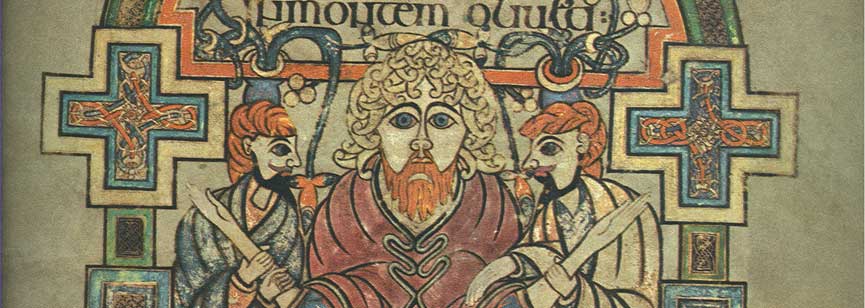
Image Detail from Gospel of Luke, Book of Kells

There may be no more famous example of an illuminated manscript than the Book of Kells. While it is well known as one of the most beautiful surviving illuminated manscripts, surprisingly, very little is actually known about the manuscript and its origins. Finally, modern science will be used to learn more about this treasure. From the Dublin Journal as reported in the New York Times:

Experts at Trinity College in Dublin, where the Book of Kells has resided for the past 346 years, are allowing a two-year laser analysis of the treasure, which is one of Ireland’s great tourist draws.

The 21st-century laser technology being used, Raman spectroscopy, encourages hopes among those with a romantic view for an ecclesiastical intrigue like “The Da Vinci Code” or “The Name of the Rose.”

But the precise subjects are more mundane. The laser will study the chemicals and composition of the book, its pigments, inks and pages of fine vellum. Experts estimate that 185 calves would have been needed to create the vellum on which the art and scriptures were reproduced.

This news happens to coincide with the opening of The Medieval Scriptorium’s on-line gallery of images from the Book of Kells. I have to admit that the gallery is not complete. I haven’t had time to finish all of the captions for the images but I decided to introduce it in this post in light of the recent story referenced above.

Technorati Tags: Book of Kells, illuminated manuscript, celtic, calligraphy

Posted in Illuminated Manuscript Galleries, Illuminated Manuscripts, Manuscript Science, Medieval Art, Medieval News, News, Poll Results, Rare Manuscripts | 1 Comment »

Poll Results – The 14th Century Black Death – Which Animal Survived Unscathed?

May 6th, 2007

Twenty-three votes were cast in the Scriptorium’s first poll. The question was about the 14th century plague popularly referred to as the Black Death. While we commonly think of the rat acting as a host for fleas and the plague bacillus, it was certainly not the only animal that carried the disease. Besides humans and rats, most animals were susceptible to the bacillus and were infested with fleas. There was, however, one exception. These animals actually repelled fleas and humans who lived and worked closely with this species enjoyed some protection from the plague. The choices presented in the poll were pigs, cows, horses and sheep. The correct answer was the horse. From “The Black Death: Natural and Human Disaster in Medieval Europe” by Robert S. Gottfried:

…important as black rats were in the dissemination of plague, it is essential to emphasize that they were not the only secondary carriers. Along the other rodents already mentioned, additional secondary vector hosts included virtually all household and barnyard animals save the horse, whose odor apparently repels even starving blocked fleas.

Since first reading that short paragraph many years ago, I couldn’t help thinking that this little tidbit of knowledge could somehow be turned into a natural flea product. I’m sure it would probably be much less toxic than the chemicals we use to treat our pets today.

Posted in Poll Results | No Comments »

« Previous Entries
  • Resident Scribe

    Your host and scribe is a student of medieval history, book arts and illuminated manuscripts. Contact email is scribe at medievalscript dot com.

  • The Scriptorium's Book Shop

  • Gallery of Illuminations

  • Enter your email address:

    Delivered by FeedBurner

  • Library Stacks

    • 11th Century Timeline
    • 12th Century Timeline
    • A Gallery of Ornamental Initials from Medieval Manuscripts
    • Medieval Medicine
    • Reference Library for the Scriptorium
    • Song and Legend
    • Synopsis of the Lindisfarne Gospels
    • The Celtic Alphabet
    • WPG2
  • Posts

    • April 2008
    • March 2008
    • September 2007
    • August 2007
    • May 2007
    • April 2007
    • March 2007
    • December 2006
    • November 2006
  • Categories

    • books (1)
    • Illuminated Manuscript Galleries (5)
    • Illuminated Manuscripts (13)
    • Manuscript Science (3)
    • Medieval Art (13)
    • Medieval Music (1)
    • Medieval News (10)
    • Medieval Women Mystics (1)
    • News (8)
    • Poll Results (2)
    • Rare Manuscripts (10)
    • Uncategorized (1)
  • Blogroll

    • Muhlberger’s Early History
    • Anitquarian’s Attic
    • BibliOdyssey
    • Got Medieval
    • Map the Universe
    • Medieval Writing
    • Musings from a Muddy Island – Juliet Doyle
    • Nib Blog
    • The Hermitary
    • The History Blog
    • The Medieval Warfare Blog
  • Book Making and Calligraphy Supplies

    • John Neal Bookseller
  • Calligraphy Tools and Lessons

    • Celtic Patterns
    • Cutting a Quill Pen
    • Making Ink
    • Medieval Manuscript Methods
    • Medieval Writing
  • Collections

    • Bristish Library – Online Gallery of European Manuscripts
    • British Library
    • Cary Collection
    • Dutch Royal Library
    • French National Library
    • J. Paul Ghetty Museum
    • Pierpont Morgan Library
  • Historical Fiction

    • Historical Novel Society
  • Master Scribes

    • Denis Brown
    • Gareth Colgan
    • Gerald Fleuss
    • Neil Bromley
    • Tanja Bolenz
    • Timothy Noad
  • Modern Day Calligraphy and Illumination

    • Calligraphy Centre
    • The Society of Scribes and Illuminators
    • Traditional Book Arts
  • Paleography

    • Medieval Writing
  • Login

    • Log in
  • Feeds

      Subscribe in Rojo

      Add The Medieval Scriptorium - A Gallery of Illuminated Manuscripts to Newsburst from CNET News.com

      Add to Google

      Add to My AOL

      Add to netvibes

      Subscribe in Bloglines

Copyright ©2006-2007The Medieval Scriptorium – A Gallery of Medieval Life and Art. Some rights reserved. Rights to the electronic reproductions of the images discussed in this reference remain with the credited sources.

Please consider exchanging links with this site